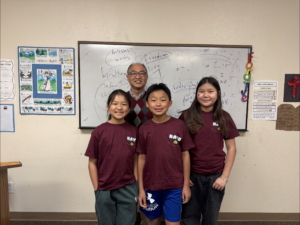

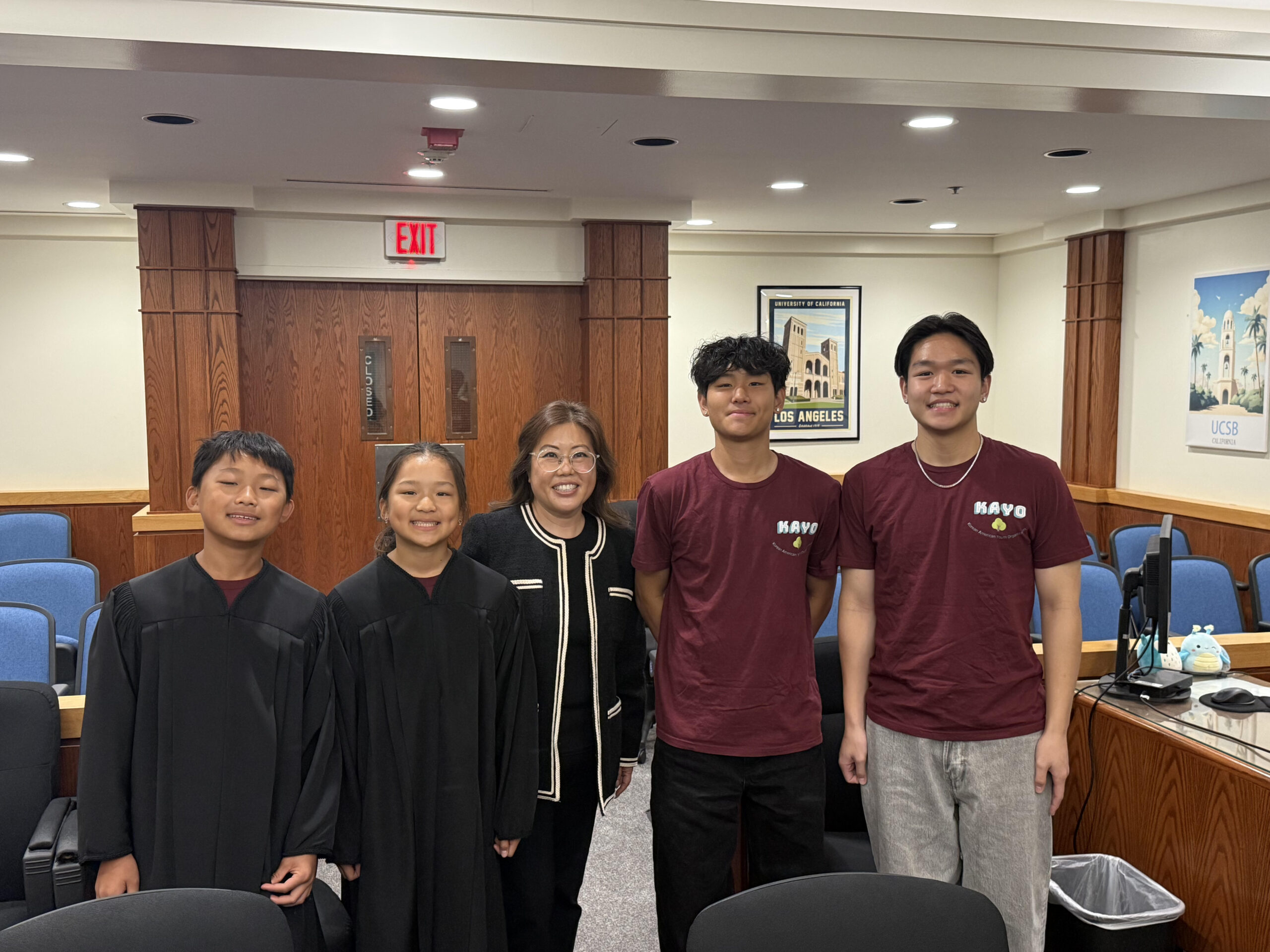
This year, KAYO Littles is proud to present an interview series celebrating leaders within the Korean-American community. For our latest installment, we had the distinct honor of sitting down with the Honorable Judge June Jee An — the first Korean American woman to serve on the Orange County Superior Court Bench and a dedicated member of its Juvenile Dependency panel presiding at the Lamoreaux Justice Center.
Appointed to the bench by Governor Gavin Newsom in December 2023, Judge An brings a distinguished legal career to her role. An alumna of the University of California, Los Angeles, she earned her Juris Doctor from Loyola Law School and was admitted to the California State Bar in 2003. Her career spans private practice, research law, and years of dedicated public service within the Orange County Superior Court, where she served first as a Probate Research Attorney, then as Deputy General Counsel, and most recently as Court Commissioner before her judicial appointment.
In this sit-down conversation, KAYO Littles sat down with Judge An to explore the professional world of the judiciary, her lived experience as a woman navigating the legal profession, and the resilience she cultivated as the child of Korean immigrants — a journey that now inspires a new generation of young Korean Americans to envision themselves in the legal world.
Q: Could you please give us a brief introduction of yourself?
A: Hello, I am Judge June An, and I currently serve on the Superior Court’s Juvenile Panel here in Orange County.
Q: Is there a special reason why you chose the path of a judge specifically?
A: There wasn’t one defining moment, but I was fortunate to have Judge Lee as a mentor early in my career. His encouragement planted the seed, and his belief in me gave me the confidence to pursue the bench.
Q: You work on the Juvenile Panel — what drew you to work with young people, and what is the most rewarding part of this role?
A: I wanted young people to have mentors and supporters in their corner, people who genuinely encourage them. I was given that kind of support throughout my own journey, and I felt a deep responsibility to give it back. That is what keeps this work meaningful to me every day.
Q: As a woman and a child of immigrants, did you ever encounter a glass ceiling on your way to becoming a judge?
A: Many times. There were moments when I was mistaken for a court interpreter rather than recognized as the attorney I was. Even growing up, I often felt different, though I always tried to find the positive in those experiences. In the courtroom, there were instances where certain individuals were visibly uncomfortable appearing before a woman on the bench. Those experiences were not easy, but they were part of my story.
Q: How did you find the courage to break through those barriers when faced with prejudice?
A: My mentors made all the difference. The network of judges and professionals who supported me gave me the strength to stay resilient and, when necessary, to defend my place. There is real power in community, and because of those relationships, I was able to succeed.
Q: How does your identity as a Korean-American influence the way you approach your courtroom?
A: I understand deeply what it feels like to have your name mispronounced, or to be misunderstood because of a language barrier. Because of that, I make a conscious effort to repeat information clearly for families who are not fluent in English, and I take care to say names correctly. It is a small gesture, but it matters. I also allow parents to have their handcuffs removed in the courtroom so they can be fully present with their children.
Q: Has your cultural background ever felt like a special power in your life?
A: Absolutely. The Korean people carry a profound understanding of resilience — having endured colonization, war, and oppression. That history gives us a unique and powerful voice. I carry that legacy with me, and I believe it deepens my sense of empathy and justice.
Q: What encouragement would you give to young girls who feel hurt or discouraged by gender or racial discrimination?
A: I would tell them that life is full of ups and downs, and the moments that feel unbearable right now will pass. Do not allow one negative experience to define your worth. Everyone has the capacity to grow into someone strong and remarkable. And when someone tries to diminish you, remember, that is a reflection of their own insecurities, not of who you are.
Q: Among the Constitutional Amendments, which do you value most, or believe was most essential to history?
A: I hold the First Amendment in the highest regard. The ability to speak freely — to tell your truth, especially in a court of law — is foundational. Without it, people are silenced and isolated. The right to be heard is everything.
Q: If you could add a new amendment to the Constitution, what right or issue would you want it to address?
A: Rather than adding something new, I put emphasis on the 14th Amendment — especially given everything happening in our society today. Equal protection and due process are rights that must be actively upheld.
Q: Is there a specific legal principle or amendment you feel must be strictly protected — or one that needs careful limitations?
A: I believe all amendments work in unison — they strengthen one another, and the Constitution is only as strong as its parts working together. I would not single one out for limitation. However, I do think the 19th Amendment deserves to be honored at every turn. The right of women to vote must never be taken for granted.
Q: From social media to school life, what do you think is the biggest challenge your generation faces?
A: In the past, an embarrassing moment stayed between a small group of people. Today, private moments can be broadcast to the entire world in seconds, and that is devastating for a young person still figuring out who they are. Research confirms that the adolescent brain is still developing, and the stimulation of social media can genuinely disrupt that growth. I worry about that deeply.
Q: For students dreaming of a legal career, what mindset matters more than just good grades?
A: The willingness to fail — and to keep going. There is so much pressure on young people today to be perfect, and that fear of failure can be paralyzing. But failure is not the opposite of success; it is part of the path to it. Embrace it, learn from it, and do not let it stop you.
Q: What does the better world you dream of look like?
A: A world where every child has enough food, proper clothing, access to medical and dental care, and the support they need to complete at least a high school education. It is not an impossible dream. It is a standard we should hold ourselves to.
Q: Finally, could you share a motto or guiding principle that has carried you through life?
A: Value yourself. Love yourself. I learned that when you push yourself to the breaking point it can lead down very dark roads: mental health struggles, substance abuse, and worse. So my motto is simple: cherish, love, value, and take care of yourself. Everything else builds from there.
Our interview with Judge An opened a door into the world of law we had never thought to walk through before. We arrived anticipating a stern figure but instead, we were met with grace, openness, and a spirit that made every exchange feel genuine. The atmosphere of her courtroom carried a softness that stayed with us long after we left. KAYO Littles is deeply honored and grateful to the Honorable Judge June An for broadening our horizons.
© 2026 KAYO. All rights reserved.